Analyzing the real x402 economy
A forensic look at what hundreds of millions of settlements reveal—and where builders should focus
TL;DR: Over 280 days, researchers classified 85% of Base’s x402 settlement count as self-payment, closed-loop, or financially linked activity. Those categories represented 71% of the $44.1 million in gross value. Another 29% reached outside identified wallet clusters, but public data could match only 0.43% of total value to a named service. The rest is unresolved (not necessarily illegitimate).
Research note · August 2026
x402 is one of the most visible attempts to give software native purchasing power. A client requests a resource, receives an HTTP 402 Payment Required response, authorizes payment, and retries the request with payment attached. No account, subscription, API key, or card form is required. The Base and Solana datasets discussed here focus on USDC, although x402 itself supports other tokens and networks.
The pitch is compelling. So are the headline numbers: hundreds of millions of settlements, tens of millions of dollars, and a growing catalog of machine-accessible services.
But there is a measurement trap. An on-chain settlement proves that a payment authorization was executed. It does not prove that an independent customer paid an independent seller, that an AI agent made the decision, or that a useful resource was delivered.
This article separates those claims. The result is a smaller—but more useful—picture of the x402 economy.
The short version: x402 is real infrastructure with real commercial activity, but raw settlement count is a poor adoption metric. Base dominates the measured datasets; operator-linked clusters dominate Base’s transaction count; and the clearest recurring product demand is for search, scraping, enrichment, crypto data, and other machine-readable context. For founders, the opportunity is less “agent money” in the abstract and more removing purchasing friction exactly when software needs a tool or action.
Start with three evidence layers
Public discussion often collapses three distinct questions:
| Layer | What can be established? | What remains unknown? |
|---|---|---|
| Settlement layer | A payment authorization was settled by a known facilitator | Whether the payer represents an independent customer |
| Counterparty layer | Value reached outside an identified payer/operator cluster | Whether hidden common control remains |
| Service-attribution layer | Payment can be associated with a named catalog resource | Whether the resource was successfully delivered and useful |
The first layer is visible on-chain. The second requires wallet clustering and value-flow analysis. The third needs server-side evidence such as receipts, response logs, refunds, or signed delivery artifacts. x402 now includes an optional Signed Offers & Receipts extension, but such evidence is not consistently available in public market datasets.
This distinction matters because x402 can make settlements cheap to generate: the buyer signs an authorization while a facilitator may sponsor gas. If rankings or ecosystem attention reward transaction count, visible activity can grow much faster than demonstrated independent demand.
Base is the center of the measured market
The most rigorous public population-scale analysis we found is the July 2026 preprint How Agentic Is Agentic Commerce?, covering 17 September 2025 through 23 June 2026.
On Base, the researchers identify x402 settlements using the USDC AuthorizationUsed event plus a curated list of facilitator relayers, then recover the authorization signer as the payer. Solana lacks an equivalent x402-specific event, so its estimate uses a coarser rule: a USDC transfer whose fee payer is a registered facilitator. The Solana figure is therefore an upper bound rather than a like-for-like census.
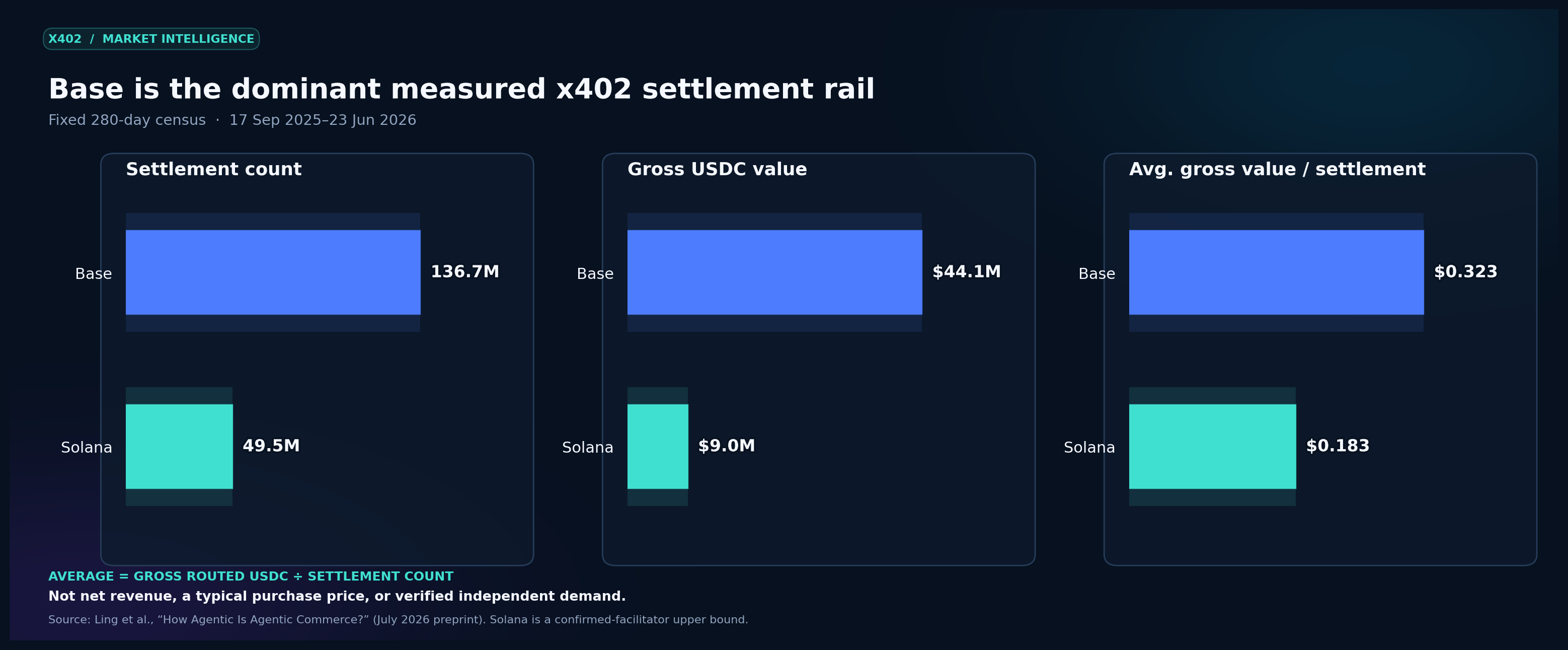
Figure 1. Fixed-window, facilitator-routed settlement activity. Average gross value is gross routed USDC divided by settlement count; it is not net revenue or verified independent demand. Solana’s count is a confirmed-facilitator upper bound.
| Chain | Settlement count | Gross value | Average gross value per settlement | Share of two-chain total | Measurement quality |
|---|---|---|---|---|---|
| Base | 136.71M | $44.12M | $0.323 | 73.4% of transactions; 83.0% of value | Strongest public census |
| Solana | 49.48M | $9.03M | $0.183 | 26.6% of transactions; 17.0% of value | Coarser upper bound |
During that window, Base handled about 2.8× Solana’s settlement count and 4.9× its gross value. The average values—$0.323 on Base and $0.183 on Solana—are arithmetic averages of unadjusted gross routed value, not typical purchase prices or evidence of independent demand. A separate July 2026 snapshot of Coinbase’s Bazaar pointed the same way from the supply side: 98% of listings accepted Base, while only around 150 used Solana as their primary network.
That does not mean x402 is technically limited to those networks. The official documentation supports numerous EVM and non-EVM ecosystems and many token types. Protocol support, production settlement support, and actual buyer demand are different things.
Most Base settlements do not demonstrate independent demand
The Base study builds a directed value-flow graph covering payments, wallet funding, and subsequent sweeps. This article groups the results into three evidence tiers:
- C1 · Self-payment or fully closed-loop: payer and payee are the same wallet, or value circulates inside a fully closed cluster.
- C2 · Operator-linked: payer and recipient are linked through strong funding or address-generation evidence, but the cluster is not perfectly closed.
- C3 · Outside identified clusters: payment reaches outside the cluster or the payer cannot be assigned to a known cluster.
C2 needs care. A custodial platform may legitimately fund many user wallets from one treasury, so linkage does not prove common legal ownership, fraud, or failed delivery. But operator-linked settlement also does not, by itself, demonstrate independent customers buying from independent merchants.
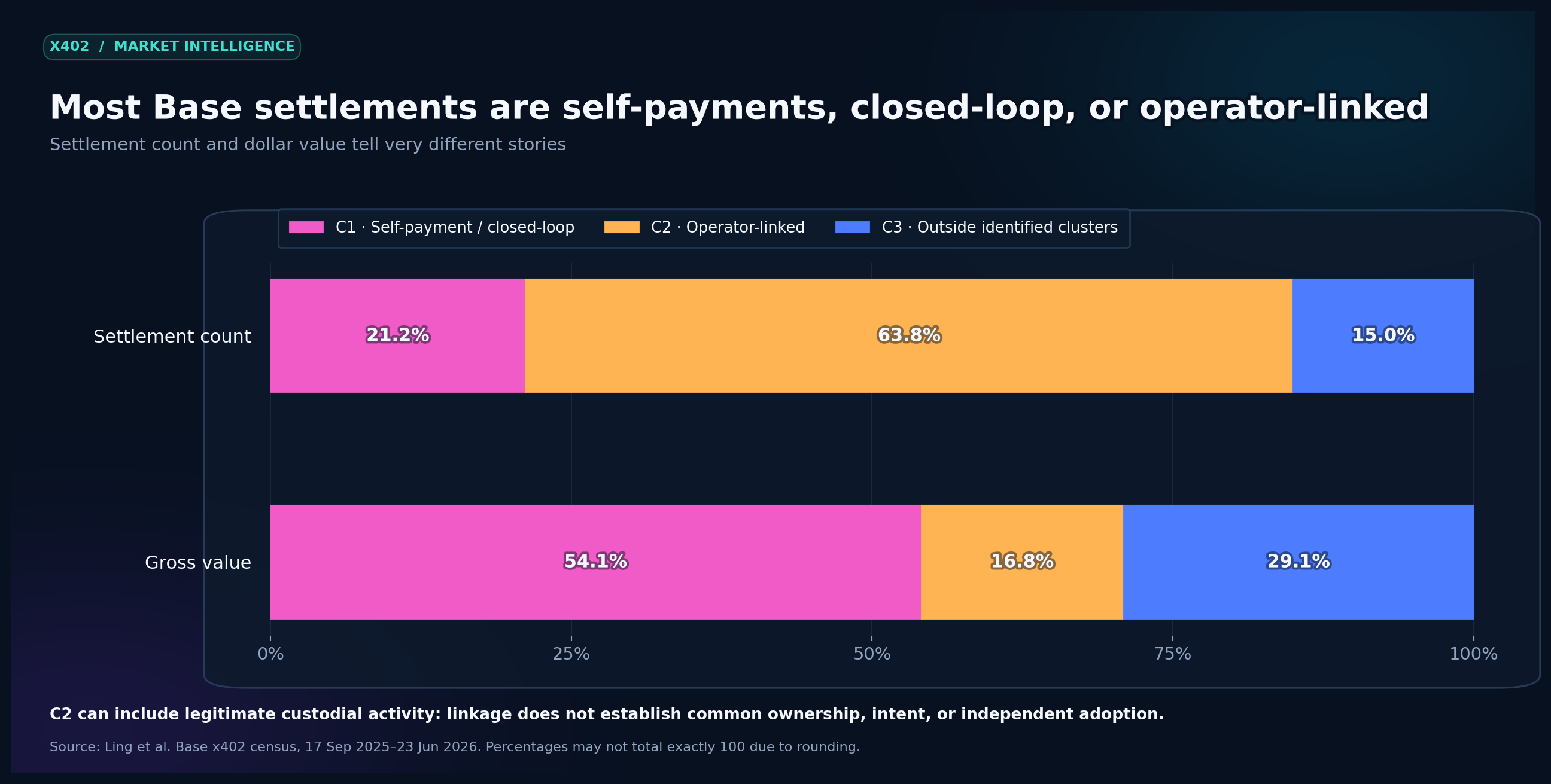
Figure 2. The count-dominant activity and value-dominant activity are different. C1 is the strict non-independent lower bound; C2 identifies financially linked activity rather than proving or disproving independent demand.
| Evidence tier | Share of settlements | Gross value | Share of value | Interpretation |
|---|---|---|---|---|
| C1 · Self-payment or fully closed-loop | 21.20% | $23.86M | 54.08% | Same-wallet payment or a fully closed value loop |
| C2 · Operator-linked | 63.78% | $7.42M | 16.82% | Linked payer/recipient cluster; not proof of independent adoption |
| C3 · Outside clusters | 15.02% | $12.84M | 29.09% | Possibly independent, but unresolved relationships remain |
Two facts stand out. First, 84.98% of Base settlement count was either self-payment, fully closed-loop, or linked to an operator-centered cluster. Second, the distribution flips when measured in dollars: C1 represented only 21.2% of transactions but 54.1% of value, while C2 represented 63.8% of transactions but only 16.8% of value. Together, C1 and C2 accounted for about 70.9% of gross value.
This is why neither transaction count nor average transaction value is a safe proxy for adoption.
A more optimistic June 2026 Chainalysis analysis points to rising wallet retention, tester-to-payer conversion, and larger-value transactions as signs of developing utility. Those signals are worth watching. The July population study adds a stricter counterparty test: retention or repeat funding is less persuasive if many wallets belong to the same financial cluster. The two analyses therefore measure different things rather than simply contradicting each other.
A strict value funnel
The same study gives a useful evidence range:
- Base settled $44.12M through identified x402 facilitators.
- Removing only self-payment and fully closed-loop value leaves $20.26M.
- Restricting the result to transfers outside identified clusters leaves $12.84M.
- Only $187,861 of that outside-cluster value reaches a service identifiable in the public catalog.
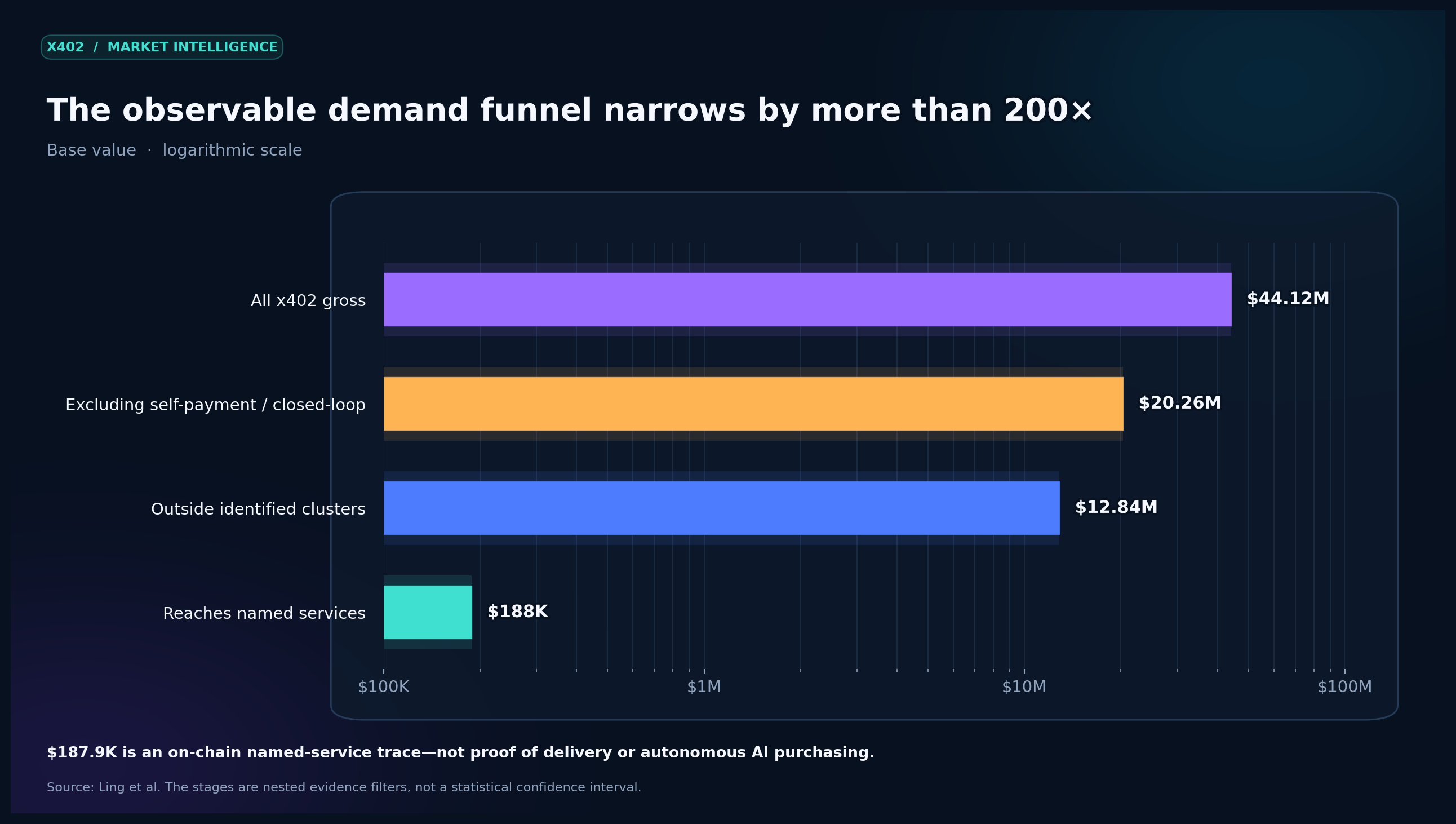
Figure 3. A logarithmic scale is required because the named-service trace is more than 200 times smaller than gross Base settlement value.
The $187,861–$20.26M band is an evidence range, not a confidence interval. The lower end is the strongest public trace of outside-cluster value reaching identifiable services; it still does not prove successful fulfillment. The upper end gives every unresolved and operator-linked transfer the benefit of the doubt.
The blockchain therefore cannot supply one defensible number for “real x402 volume.” It can identify a large self-payment, closed-loop, or operator-linked component, a much smaller identifiable-service component, and an unresolved middle.
Settlement generation is highly concentrated
Three sources dominated Base settlement count in the study. The two operator-linked groups are intentionally anonymized because the graph classification does not establish legal ownership or intent.
| Cluster or campaign | Approx. share of Base settlements | Approx. settlements | What the graph shows |
|---|---|---|---|
| Largest operator-linked cluster | ~23% | ~31.6M | Hundreds of payer wallets linked to a common recipient through funding and sweep-back patterns |
| Second-largest operator-linked cluster | ~22% | ~29.7M | Large payer/recipient group linked through funding and address-generation evidence |
| Nov. 2025 self-payment campaign | ~20% | ~27.5M | Three wallets produced almost all self-settlements and stopped within the same two-second window |
Together they generated roughly 65% of Base settlement count; the top 20 operator-centered payment communities generated 93%.
Facilitators are also easy to mistake for users. Coinbase relayed 86.86 million Base settlements in the study—63.5% of the total—followed by PayAI at 23.52 million and Daydreams at 11.81 million. Those relayer addresses identify payment infrastructure, not who wanted the underlying resource.
The buyer side remains largely pseudonymous. Public data can observe authorization-signing wallets and repeat behavior, but cannot reliably map them to humans, businesses, scripts, or autonomous agents. Claims that “AI agents spent X” therefore exceed what the chain alone proves.
A second lens: what buyers appear to want
The analysis now changes datasets. The blockchain census is useful for settlement structure but poor at describing what was purchased. To examine products, we switch to a separate 11 July 2026 snapshot of Coinbase’s Bazaar. Its dollar totals are not directly comparable with the $44.12 million Base census above.
The Bazaar analysis downloaded all 25,443 catalog resources and used trailing-30-day payer and call counts. For exact payments, it estimated volume as listed price × calls. The snapshot contained about 262,000 paid calls and $26,000 of catalog-associated exact-scheme volume over 30 days.
That is not an all-market GMV estimate or a counterparty-adjusted revenue figure. Dynamic prices are approximate, upto payments expose only a ceiling, and catalog statistics cannot prove fulfillment. Its value is narrower: showing which products attract repeated usage.
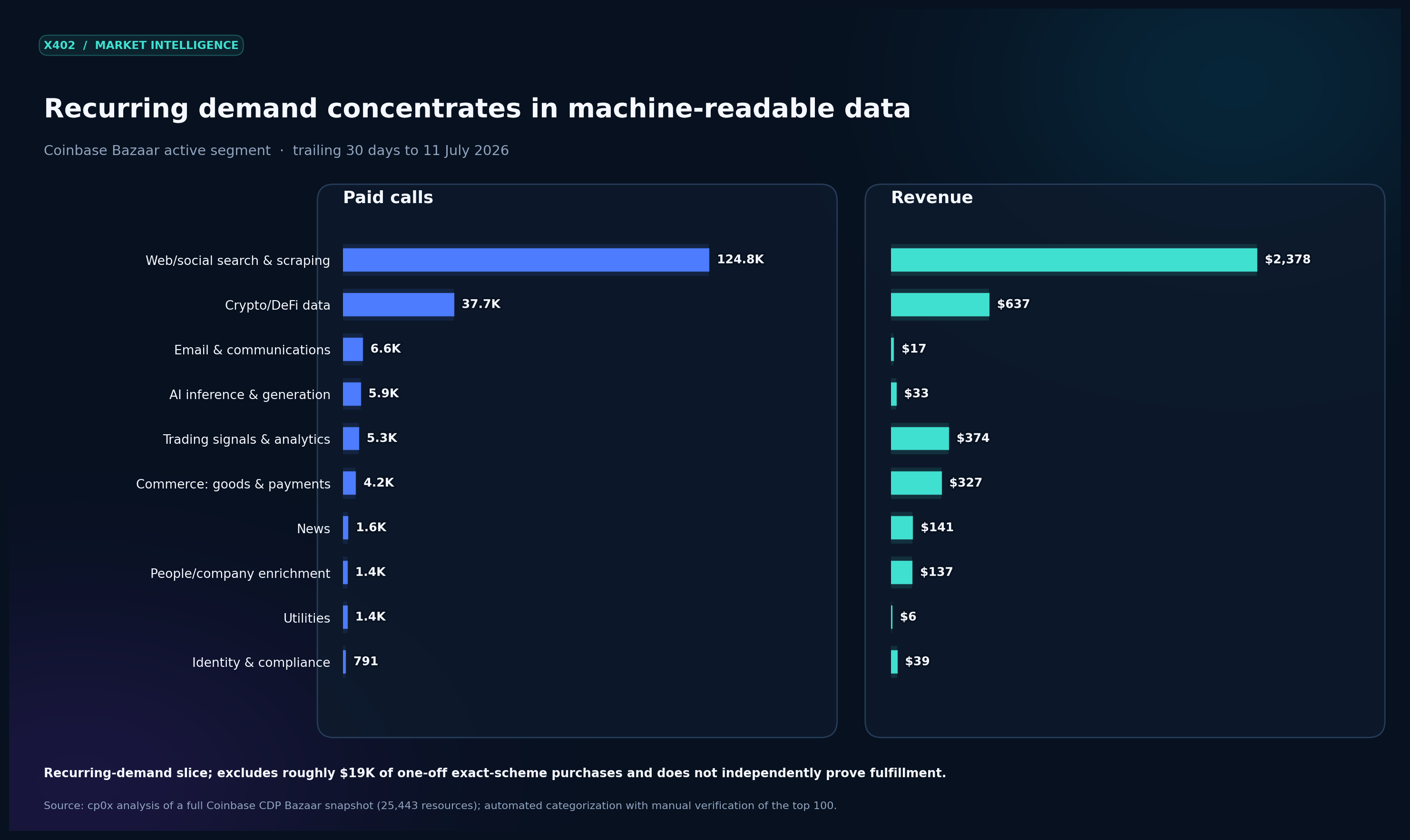
Figure 4. Active segment of the July Bazaar snapshot. The table excludes larger one-off exact-scheme purchases and upto invoice ceilings.
| Category | Paid calls, 30d | Volume, 30d |
|---|---|---|
| Web/social search and scraping | 124,800 | $2,378 |
| Crypto/DeFi data | 37,730 | $637 |
| Email and communications | 6,572 | $17 |
| AI inference and generation | 5,895 | $33 |
| Trading signals and analytics | 5,309 | $374 |
| Commerce: goods and payments | 4,242 | $327* |
| News | 1,632 | $141 |
| People and company enrichment | 1,389 | $137 |
Exact payments in the active segment only; larger one-off purchases and upto invoice ceilings are excluded.
The clearest recurring pattern is buyers paying for eyes on the internet:
x402.twit.shrecorded around 64,000 calls, including 55,000 to one Twitter/X search endpoint from 34 clients.- Tavily recorded roughly 20,000 calls from 197 payers.
- StableEnrich generated about $940 in monthly volume by reselling account-free access to providers such as Exa, Firecrawl, Whitepages, and People Data Labs.
- Crypto and DeFi data generated substantial call volume but low revenue because commodity pricing and RPC data are heavily oversupplied.
The product lesson is simple: the strongest x402 services today often sell frictionless access rather than unique data.
The more interesting shift is from data to actions
Smaller categories point toward a potentially larger market: payments where the purchased resource changes state or causes something to happen.
Examples in the Bazaar snapshot included:
- 62 Bitrefill gift-card and eSIM invoices using a price-locked flow.
- Eleven exact-scheme purchases of tokenized gold at $1,000 each.
- A swap-execution endpoint with 161 monthly payers.
- 22,000 paid Chainlink workflow executions from a small number of repeat clients.
- 2,785 payments to hire or tip a particular agent.
- Prepaid Browserbase sessions used for browser automation.
Informational API responses often have free or bundled substitutes. Successfully executing a purchase, swap, browser session, workflow, or hired task is less substitutable by a free informational endpoint. That is where x402 starts to look less like “an API key without an account” and more like a transaction rail.
What the early market says to entrepreneurs
1. Build for buyer friction, not endpoint supply
The ecosystem does not lack listings. Of the 25,443 Bazaar resources, 6,282 had at least two distinct payers over 30 days, 962 had at least five, and 257 had at least ten. The sharper constraint is getting software buyers equipped with wallets, budgets, policy controls, and trustworthy discovery.
Wallet orchestration, spending limits, refunds, receipts, and high-quality discovery may therefore have more leverage than another generic paid API.
2. Sell access that is inconvenient to obtain elsewhere
The clearest demand appears where the alternative involves account creation, API-key management, minimum commitments, geographic restrictions, or brittle scraping. Search, social data, enrichment, browser sessions, compliance checks, and premium research fit this pattern.
Commodity token prices, basic RPC wrappers, utilities, and generic news can still attract calls, but their low prices and high substitutability make monetization harder.
3. Prefer execution over commodity responses
The strongest long-term wedge may be payment for action: purchase an item, run a workflow, book compute, execute a swap, submit a job, register a domain, or hire another agent. Payment becomes part of the action rather than merely another way to buy JSON.
4. Make verifiable fulfillment visible
x402 already supports optional signed offers and receipts. Builders can go further by exposing those artifacts alongside payment identifiers, response hashes, idempotency identifiers, refund behavior, latency, and availability. The product opportunity is not inventing a receipt mechanism; it is making request → payment → delivery → retained value auditable in practice.
5. Do not optimize for raw transaction count
When settlement is cheap and gas can be sponsored, transaction count is vulnerable to Goodhart’s law. Teams should manage the business using metrics that remain meaningful even when related wallets or operators can transact with themselves.
Measure demand, not activity theater
| Metric | Why it matters | Minimum control |
|---|---|---|
| Outside-cluster value ratio | Separates value reaching beyond identified operator clusters | Exclude self-payments, shared funders, and sweep-back loops |
| Repeat independent payers | Measures recurring demand | Count entities or clusters, not raw wallets |
| Calls per independent payer | Distinguishes integrated usage from one-wallet-per-call patterns | Segment one-call wallets and common funding |
| Verified fulfillment rate | Connects payment to delivered output | Capture signed receipts or equivalent service evidence |
| Net retained value | Detects recycled capital | Track value returning to payer funders |
| Revenue concentration | Exposes dependence on one buyer, endpoint, or campaign | Report top-1/top-5 shares and concentration metrics |
| Contribution margin | Tests whether micropayments cover real costs | Include upstream data, inference, facilitator, gas, and refund costs |
| Refund and dispute rate | Measures failed fulfillment | Report completed, refunded, disputed, and expired requests |
For developers, the reconciliation path is straightforward: attach a unique payment identifier to the quote, preserve the payer authorization and resource URL, record settlement, capture a signed success or refund artifact, and track whether value remains with the seller.
What would make the adoption case stronger
The current evidence does not say x402 cannot grow. It says its most visible activity counter can rise without demonstrating equivalent independent demand.
The case for a broad economy of independent buyers and sellers becomes stronger if:
- Independent payers grow faster than payments per existing wallet.
- Value reaches a broader set of unrelated sellers.
- Signed service-level evidence makes successful fulfillment observable.
- Agent frameworks ship wallets, policy controls, and x402 clients by default.
- Higher-value action and commerce flows grow without depending on token rewards.
- Activity remains resilient after gas subsidies, rankings, or incentive campaigns are removed.
Those tests are harder than cumulative settlement count—and therefore more convincing.
Conclusion
x402 has solved a real technical problem: software can encounter a price, authorize payment, and obtain a digital resource without a pre-existing commercial relationship.
What it has not yet demonstrated is a large, decentralized economy of autonomous buyers and independent sellers.
In the best public census, Base dominates the measured market and most Base settlements are self-payments, fully closed-loop flows, or linked to operator-centered clusters. The identifiable-service signal is much smaller, and public blockchain data cannot prove fulfillment or autonomy. At the same time, recurring commercial usage is visible in search, scraping, enrichment, crypto intelligence, workflow execution, and early commerce.
For entrepreneurs, that combination should be encouraging rather than disappointing. The infrastructure works; the buyer side is immature; and the market has begun to reveal where machine-native payment is genuinely useful.
The winning builders are unlikely to be those who produce the largest transaction counter. They will be the ones who make a software buyer’s next purchase easier, safer, verifiable, and economically useful.
Sources and methodology notes
- Shengchen Ling, Yajin Zhou, Lei Wu, and Cong Wang, “How Agentic Is Agentic Commerce? A Population-Scale Measurement of x402 Adoption and Authenticity”, July 2026 preprint.
- x402 Foundation, Networks and Token Support.
- x402 Foundation, Signed Offers & Receipts.
- Chainalysis, “Agentic Payments Cross the Threshold: Inside x402’s Path to Meaningful Adoption”, June 2026.
- philpher0x/cp0x, “Where’s the Money in x402: An Analysis of Coinbase’s Bazaar Catalog”, July 2026. Snapshot of 25,443 Coinbase Bazaar resources; volume estimated from catalog prices and call counts, with stated limitations for dynamic and
uptopricing. - x402scan, network and facilitator activity dashboard. Live dashboard values are useful as a current pulse but are not adjusted for payer-recipient relationships or circular value flows.
All dollar figures are nominal values reported by the cited sources. The analysis distinguishes observed self-payment and fully closed-loop flows from operator-linked activity that may include legitimate custodial architectures. These categories describe observable relationships; they do not establish whether services were delivered or whether any participant intended to mislead. Nothing in this article alleges unlawful conduct by any operator.
Disclosure: This report was produced by a human with research and editorial support from ChatGPT.